Han Solo frozen in Carbonite is one of those movie icons that never ceases to be popular. Call it a classic. But now you can get your own such figurine, except instead of Han Solo’s face you can have your very own likeness. First you have to go to Disney World in Orlando during a Star Wars Weekend, which is a special event celebrating the movies and such. Then you go to the Carbon-Freeze Me area where you’ll sit for about 30 minutes while expensive cameras take your pictures from several different angles. Once you’ve found that perfect shot, you pay a cool $99 plus shipping and go on your day. 4 weeks later your 8 inch figurine will arrive in the mail. You also get a commemorative bracelet for your troubles.
Know that this starts on May 18th, but that you’ll have to reserve your spot in advance and you must have purchased tickets for the theme park as well. You can reserve now by calling 407-WDW-TECH (407-939-8324).
Back in August of last year, we reported on this device that made spherical ice for proper whisky consumption. It worked… but cost $800. Today we present you the Tovolo Ice Sphere Mold. Instead of taking a large chunk of ice and pressing it into a ball, why not simply freeze it into that shape to start with? And save, oh, $785? Yeah, see, for $15 you can get this here mold and chill your beverage in the most efficient manner that doesn’t involve whisky rocks.
Granted, this won’t work in a bar setting, where you’ll likely need to keep making several spheres throughout the night. That was the target market for that other press. But for the home, this right here will do. Incidentally, it’ll give you 2.5 inch ice balls.
The ENVY line of laptops from HP has typically gotten some pretty decent reviews. The “ENVY 6t-1000 features Beats audio with dual speakers, a subwoofer, HDMI port, full-size keyboard (optional backlit +$20 upgrade), two USB 3.0 ports, HP CoolSense technology and up to 8.25 hours battery life.” The particular model on special today comes with a Core i5 processor, as well as 4GB RAM, 500GB Hard Drive + 32GB mSSD, and Intel HD 3000 graphics. Usually selling for $899, after today’s rebate you’re looking at $789. Shipped.
Batteries are great, but their own technology isn’t progressing as fast as the one they usually power. While smartphones are getting increasingly fast and small, batteries have pretty much plateaued. So that’s why we welcome solutions like the above pocket-sized fuel cell that is allegedly capable of charging an iPhone 10 to 14 times on a single cartridge of butane. We use the iPhone as a measuring stick here, but the device will use a USB connection so anything that uses that can be charged with it. The fact that it’s cartridge based means it can be taken with you in an airplane, so you might be able to make it through those long flights even if your seats don’t feature a plug. It’s made by Liliputian Systems but will be sold by Brookstone and labeled with that name. And we don’t really know for how much though we’re told they’ll be available “later this year.”
Maybe you watched Star Trek IV and thought the idea of having a whale tank made from transparent aluminum to be one of those far fetched sci-fi gimmicks. But would you be surprised to find out that at the time the movie was made, that particular material already existed? Not from the metallic aluminum you know and love, mind you, but from an aluminum-based ceramic called aluminum oxynitride, aka “AlON.” You may be thinking to yourself that this is not the same, but hey, this is still a transparent, aluminum-based material that is capable of stopping a .50 bullet with a plate 1.6 inches in thickness. A 3.7 inch slab of laminate glass not only doesn’t stop this same bullet, but lets it go through with enough speed for it to do some serious damage to a dummy skull on the other side.
Transparent aluminum starts out as a pile of white aluminum oxynitride powder. That powder gets packed into a rubber mold in the rough shape of the desired part, and subjected to a procedure called isostatic pressing, in which the mold is compressed in a tank of hydraulic fluid to 15,000 psi, which mashes the AlON into a grainy “green body.” The grainy structure is then fused together by heating at 2000 °C for several days. The surface of the resulting part is cloudy, and has to be mechanically polished to make it optically clear.
Of course this material is super expensive, and is usually reserved for high-performance military applications. “AlON is manufactured by Massachusetts-based Surmet Corporation for use in armored windows, lenses for battlefield optics, and “seeker domes,” which are the clear round windows covering the sensor heads on the business ends of many missiles.”
Back in February we reported about the Cryoscope, a device that lets you feel the outside temperature by adjusting its own to match it.
[It uses a] heat sink, a fan and a Peltier element, which is a thermoelectric pump. An Arduino brain fetches tomorrows forecast based on your previously entered zip code, and the device automatically adjusts its external temperature from 32F (freezing point) to 100F (tropical heat).
Back then we didn’t know if you could even buy one, and as it turns out you couldn’t back then. But today you can pre-order your now redesigned Cryscope on Kickstarter for $300. For cost and aesthetic reasons it’s no longer a cube but a crystal shape. It’s still made out of Aluminum.
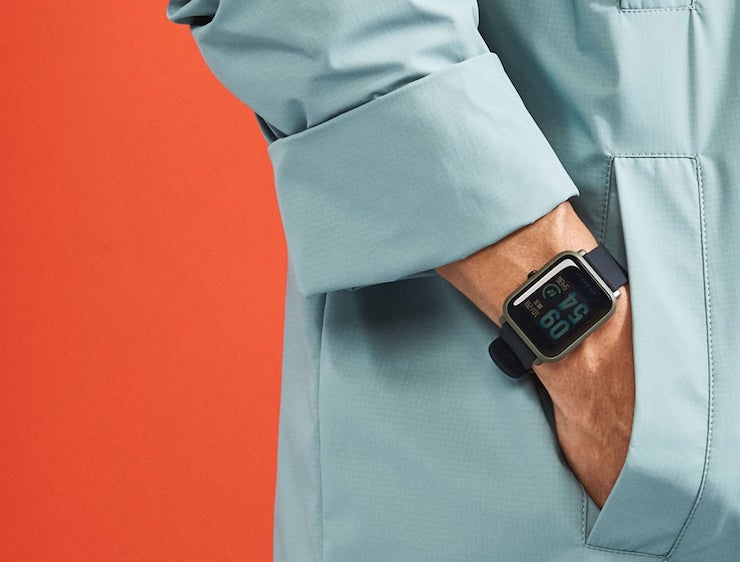
You know we like us some Tokyoflash watches, with their obtuse time telling schemes and bright designs. We make a point to report on every new release and we’re pleased to announce Kisai Uzumaki, the sixth concept from a fan to become reality. Unlike most of the company’s watches however, this one doesn’t make it too hard to tell what time it is, instead focusing on its appearance. Uzumaki means whirlpool in Japanese and the timepiece aesthetic cues all revolve around this. Particularly striking is the “custom made acrylic lens, designed with concentric circles that descend from the edge of the case into the centre of the watch to create the appearance of a whirlpool.” Time is told simply, like a regular analog watch, with the hours on the outside and the minutes on the inside. The rotating hand indicates the seconds, for precise time telling.
It’s $99 for the next 44 hours, after which it goes up to $129.
There are those who believe that time is nothing but a human construct, an imaginary notion that only exists because we do. It’s a little metaphysical and we don’t know enough about the topic to weigh in either way, but we can attest to the fact that time definitely feels a lot more variable than it is. When you’re having fun, it just flies by, whereas second feels like an hour when you’re bored. The TicTocTrac watch is a project from a couple of students from Cornell University that not only tells time like a regular timepiece, it also lets you measure your own perception of its passing. The way this is done is by first activating the watch through a double tap gesture, at which point it will briefly flash a random number between 5 and 55. This is the amount of minutes you’re supposed to estimate, and you have to double tap the watch again when you think this amount has elapsed. The device will then tell you if you’re over or underestimated and by how much. You can also save this number to an SD card, allowing you to plot your performance over time.
The practical use of all this? None really, but it is interesting nonetheless. Not enough to make it a commercially available product though, so if you want in on the action, you’re going to have to build it yourself with the instructions found at the link below.
A video game doing phenomenally well is not exactly anything new. Every new release of Modern Warfare breaks the previous records it set itself. But the continued success of Angry Birds is interesting to us because it signals a robust and growing mobile gaming market, and the latest news from Rovio should quiet anyone thinking that this segment will never rival that of traditional consoles. While nowhere near MW3′s billion dollars in 16 days sprint, the Finnish company announced that in 2011 it “made a huge $106.3 million turnover and a whopping $67.6 million in profit (before tax).” It grew from 28 employees to 224 and that their three games (Angry Birds, Seasons and Rio) were downloaded a total of 648 million times. Keep in mind that this doesn’t include Angry Birds in Space, which reached 50 million downloads in 35 days. So yeah, Rovio’s minting it right now and while they can’t play with the big boys just yet, we think it’s just a matter of time until they do.