The company that introduced the world to the netbook with their EEE is now introducing a system at the other end of the performance spectrum.
The Asus ESC 1000 is essentially a desktop supercomputer with a speed of 1.1 teraflops thanks to a 3.3 GHz Intel LGA1366 Xeon W3580 server processor, 960 cores inside three Nvidia Tesla c1060 graphics processing cards coupled with a Quadro FX5800 GPU. The system also includes 24GB of DDR3 1333 MHz RAM, a 500GB SATA II hard drive and a high-capacity 1100 watt power supply. All for just over $14,500 according to PC Advisor.
I’ve walked past this display a few times over the last couple of weeks and figured I’d grab some photos of it last night. What you see there is a Tesla Roadster sitting on top of four tea cups in front of a William Ashley China store. Now one downside critics often cite when it comes to electric cars is the added weight from the large batteries, and according to this display the tea cups under the front wheels of the Tesla are each supporting 481 pounds while the tea cups under the back wheels each have to deal with 894 pounds. So if it’s not heavy enough to shatter a set of tea cups, I guess it’s nothing to worry about right?
The easy route here would have been to find 32 old vacuum tubes and simply dress them up like standard chess pieces, but artist Paul Fryer opted to take the difficult route instead. His ‘Chess Set for Tesla’ still features 32 vacuum tubes, but they actually connect to each square on the chess board and when plugged in they show an icon on top representing what piece they are. According to the All Visual Arts site there were actually 7 of these produced, but since it was created last year I have my doubts any of them are still available.
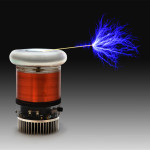
Telsa coils are just plain cool. Of course they’re not usually the sort of thing that you just put together in your garage one day. Or are they? One man decided to go raiding a few dumpsters and looking through his garage for the necessary parts. He managed to find them, and make a pretty decent little Telsa coil. Here’s a rundown of what he used:
Primary power source: Small neon sign transformer
Discharge capacitor: High-voltage television capacitors
Spark gap: Pair of 1/4-in. bolts and nuts
Primary coil: Lamp shade and electric cord from a humidifier
Secondary coil: Cardboard tube and microwave fan wire
Secondary grounding: Metal spike pounded into the ground
Torroid: Two stovetop grease catcher pans
Chokes: Two Bic pens and wire from a RC car tossed away
Naturally, as with any DIY project like this, you’re going to want to be really careful. I’d advise looking through the instructions that the guy posted so as to get everything right.
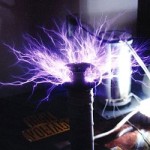
One of the most popular attractions at Maker Faire are the Tesla coils. There were several scattered around, although the most prominent are the twin 10-foot coils constructed by Nevada Lightning Lab. The coils have no problem bridging a 25 foot gap with several million volt discharges, and they can wirelessly power nearby electronics as well as cook hot dogs.
There was also a somewhat smaller (okay, WAY smaller) coil from the Santa Cruz Institute for Particle Physics. It was a sparky little guy, though, and a brave grad student (or a not-so-brave one who knows how electricity works) donned a suit of metal armor and did battle with the electrons.
More pics, including a lovely closeup of a discharge and a long exposure of a three phase Jacob’s ladder, after the jump. (more…)
Why on Earth would anyone want to cook a bunch of hot dogs with a gigantic tesla coil, you ask? Because it’s AWESOME, that’s why. This is pretty much the philosophy behind Maker Faire: things are worth making and building and creating and doing because (first) they are awesome and (second) because they are useful. Sort of. Sometimes. But who cares! Awesomeness!
Maker Faire is an exposition and celebration of people and the awesome stuff they make. It’s the biggest DIY festival in the world, and this year there will be more than 600 Makers showing off their wares and talents, including robots destroying dinosaurs, compubeavers, candyfab machines… Oh, and tesla coils, did I mention those? And we’ll be there, so check back this weekend for lots of pics.
As sexy as the Tesla Roadster is, and as much as I want one, it’s really just a big expensive toy. It’s not a practical car for a consumer (i.e. people who have kids and need to bring home their own groceries) to purchase. Tesla gets this, and has just unveiled their new Model S electric sedan concept that we first got a glimpse of back in October of last year.
The Model S has four doors, and is apparently capable of seating seven people… Five adults, plus two kids in a rear facing seat in the back. Inside, the most notable feature is a 17″ touchscreen in the center panel, which controls the climate, navigation, and entertainment systems, has 3G connectivity built in, and features auxiliary and iPod inputs. It also manages to have more cargo space than a station wagon, thanks to a second trunk under the hood.
Details on the drivetrain, and more pics, after the jump. (more…)
Shelby SuperCars released details and specs yesterday on what could be the world’s fastest (and possibly best looking) production electric car. The Shelby Ultimate Aero EV has 1000 HP, 800 lb-ft of torque, and goes 0-60 in 2.5 seconds on its way to 208 mph. These are not the most impressive numbers, though… The Aero EV has a range of 150-200 miles, and can fully recharge in ten minutes from a 220 volt appliance outlet.
The Ultimate Aero EV is powered by Shelby’s All-Electric Scalable Powertrain (AESV), a modular system which incorporates both electric motors and charging technology and is available with anywhere from 200 to 1200 horsepower. The idea is that you (you being vehicle manufacturers) buy Shelby’s AESV system and then stick whatever you want on it. If this works out, it could drastically mitigate one of the biggest problems with electric cars like the Tesla Roadster, and even the Aptera: the hours-long recharge times.
Well, it looks like the Tesla roadster is now officially a legitimate car, since it’s shown up on the most authoritative (and grounded and unbiased) car show in the known universe: Top Gear. Jeremy Clarkson goes over some things we know already, like the Tesla’s massive amounts of torque and correspondingly sprightly acceleration, which helps is to trounce the Lotus Elise (that it shares a platform with) in a drag race. Looks like that new single speed transmission that we heard about back in April is working out just fine. He also says it’s ten times cheaper to fill it up (or whatever you want to call it) than the Elise, but that’s in Britain, where gas petrol is something like $6 a gallon £1 a litre.
As you might expect if you’ve ever seen Top Gear before, Clarkson also has some criticisms, most notably a range of “55 miles” and a charge time of “16 hours.” Also, the motor overheated and the brakes failed once. Unsurprisingly, a spokesperson from Tesla has a few apparently quite legitimate quibbles with some of this, which you can read after the jump. (more…)