Lasers, is there anything they can’t improve? Regular tag? Boring. Laser tag? Amazing! Regular pointers? Dull and ignorable. Laser pointers? Captivating! And it turns out that lasers can work their magic when it comes to pico projectors too. Last year I reviewed AAXA Technologies’ P1 Pico Projector, and the biggest gripe I had with it, and with every pico projector I’ve played with since then, was the fact that you had to constantly refocus the image whenever the projector was moved. And given they’re designed to be handheld most of the time, they move a lot.
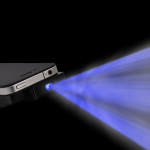
Since the light from an LED tends to diffuse quickly, the image from an LED-based pico projector constantly needs to be refocused as you change its throw distance. But since the light from a laser has a high coherency and manages to stay very focused over long distances, the image from a laser-based pico projector never needs refocusing. In a nutshell it’s a clever solution to the issue I raised in my previous review. Now granted the technology isn’t perfect just yet, but as far as I’m concerned the new L1 from AAXA Technologies is now the pico projector to beat. And if you want to know why, you can find my full review after the jump.
Remember the I-Tech Virtual Laser Keyboard? It was a little pod-like device you sat on your desk that projected a red virtual keyboard you could actually type on. Well the Light Touch is basically the same idea, but with about 5 years of technological advancement behind it. Instead of just a red keyboard you get an actual full-color, WVGA 10.1-inch virtual touch screen which is powered by the company’s Holographic Laser Projection technology. No DLP here.
The touching part functioned well enough, I mean it was no iPhone, but the infrared technology it was using even allowed for parts of the GUI to be dragged around. However, even in their subtly darkened booth the projected display was kind of washed out, particularly when compared to the results seen from 3M’s and other companies’ latest crop of pico projectors. But the Light Touch is really just a proof of concept anyways since the company has no plans to produce the device themselves, but will be licensing the technology to other OEMs.
While they had little to no information about the phone itself, the good people at Texas Instruments were showing off this unnamed Samsung phone (I believe the model # 9600 was thrown around?) since it features a built-in DLP-based projector. While it’s not as thin as the Nexus One or the iPhone, it’s still remarkably compact given there’s a projector crammed inside! And a decent one at that!
Now a crumpled piece of copier paper isn’t the most ideal thing to use as a projection screen, but to be honest it’s pretty close to real world conditions. I mean if I was at my desk and wanted to show someone something via the projector, it’s probably the first thing I would reach for. And the projected image was suitably bright with decent contrast, so we’re definitely getting there!
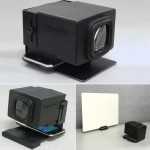
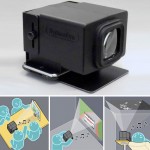
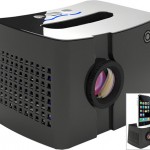
Jealous of all those new-fangled cellphones that come with built-in projectors these days? Well the HypnosEye will level the playing field. It seems to work like an overhead projector, using a mirror and lens to magnify and project the display from your cellphone onto a wall, ceiling or other surface. There’s no light source of its own, so you’ll need to set the brightness on your phone’s display as high as it can go for best results, which also means it will probably work better with devices with large LCDs like the iPhone, iPod Touch, Zune etc. Unfortunately though the $117 price tag from the Japan Trend Shop pushes this well out of the novelty purchase price range, particularly when the results as seen in the video I’ve included after the jump aren’t great.
While we’ve seen our fair share of projectors for the iPhone, all of them work by taking the device’s video feed, amplifying it and projecting it onto a surface. Not so for the HypnosEye. It simply uses a lens and a mirror to project images from your iPhone’s (or iPod touch, we suppose) screen directly to a projection screen. No amplification.
rather than use an ordinary mirror which would result in an unclear image, HypnosEye has implemented a special mirror with a reflection agent on top of the glass surface (rather than behind). As a result, you can show media from your portable device almost anywhere at anytime.
For the full specs, price and a video, keep reading.
When you think about it, a video projector small enough to fit in your hand is one of those ‘best of both worlds’ ideas. You get the portability of a device like the iPhone, with the big-screen viewing experience of a projector. And while micro projectors have been promised for the past few years, it’s only recently that we’ve begun to see affordable models hitting the market. Now prior to this review, the only experiences I’ve had with micro projectors was at trade shows where the lighting conditions were never ideal, and needless to say I wasn’t exactly impressed.
But AAXA Technologies sent us over one of their P1 Pico Projectors which I had the opportunity to test out in the comfort (and controlled conditions) of my own home. I’ll admit that I walked away with a different opinion on the technology, and while it’s far from perfect at this point (you’ll have to settle for a few compromises) I’m sure one day micro and even embedded projectors will be as commonplace as digital cameras are in cellphones today. Hit the jump for my full review.
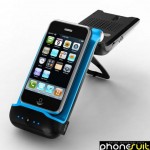
iPhones and iPods can be great for watching videos, but only if a single person is trying to view them. However, if you’re wanting to show something to a group of people, you’re not going to want them to crowd around your tiny screen are you? Well later this year you’ll be able to pull out a small accessory that will make your videos large enough to be viewed by all.
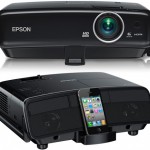
The Mili Pro LED projector is a cool little dock for your iPhone or iPod Touch. Just slide your iPhone into place and it will project an image roughly equivalent to a 40-inch TV. The picture will be displayed at 640 x 480, which isn’t going blow your mind with its clarity, but it will get the job done. Having something this small that hooks up to your iPhone/iPod Touch (or any other device using VGA or RGA connectors) would certainly be appealing for the business types giving presentations, or anyone else just wanting to show off video on a bigger scale. Look for this in September for around $300.
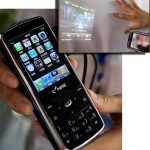
Just last week 3M announced that their MPro110 handheld projector would be shipping on September 30, which was great news for those who’ve been following the development of mini projectors over the years. Their palm sized projector weighs just a third of a pound which is an impressive feat, but the real ‘holy grail’ of mini projectors would be the oft-promised version that’s small enough to fit into a cellphone. So given that 3M is the first company to get a handheld projector to the market, I’m kind of surprised to see that Chinavasion is already selling a projector equipped cellphone.
It’s a tri-band GSM model that features all of the options you’d expect on a smartphone these days like a touch screen, bluetooth, digital camera, microSD card slot and what appears to be a bastardized version of the iPhone OS, but it also includes a built-in 640×480 projector, which is definitely something most consumers would not expect. The photo above shows a supposed actual projection from the phone, but the video I’ve included below seems a bit more indicative of what the projector’s quality is really like.
The phone itself isn’t tiny by any stretch of the imagination, but part of its girth comes from the 1800mAh battery which provides up to 3 hours of talk time, and about 2 hours of projector use. Now obviously the phone can’t compete with the quality of a full-sized projector, but with a price tag of about $370 I’m sorely tempted to order one just to see it working in person.
We’ve seen prototypes. We’ve heard announcements. But finally, someone has gotten something out to the consumer, and it’s (again) not Motorola: it’s 3M, with their $359 MPro110 which should be shipping on September 30. The fanless, speakerless, LED lamp palm sized projector weighs only a third of a pound but can display a VGA image (640 x 480) up to 50 inches diagonally at any surface you care to point it at. It’s got VGA and composite video inputs and I assume a battery in there somewhere, although there are no specs on that. You focus it with a thumb wheel. How’s it look? According to Popular Science, who got a peek at a production version:
Images were discernable up to about 11 inches across, even under our bright fluorescent office lights. But they were definitely faded. And some movie scenes were downright indecipherable. The same went for photos. In a dark room, it could project a big enough image to be the ultimate cheap-o home theater.
It doesn’t sound like it’s quite as bright as the prototypes we’ve seen, but so far 3M has been the only company to actually push one of these through to the shelves. I’m really not sure, though, whether this is going to kick off a whole generation of palm-sized projectors, or if the real progress (and money) is in integrated projectors. My money would be on the latter, but it remains to be seen how long it takes to get there.